
How IoT sensors enable real-time monitoring across factories, data centers, and smart buildings — and how to implement AI-powered systems that turn live telemetry into action.
In today's Industry 4.0 era, businesses are rapidly adopting IoT (Internet of Things) technologies to achieve smarter, faster, and more efficient operations. From factories and data centers to agriculture and smart buildings, IoT sensors are becoming the backbone of real-time monitoring systems.
Real-time monitoring allows organizations to continuously collect, analyze, and visualize live data from equipment, environments, and industrial processes. By integrating IoT sensors with cloud platforms and AI analytics, businesses can reduce downtime, improve operational efficiency, and make data-driven decisions instantly.
This article explains how IoT sensors work, how they enable real-time monitoring, and how businesses can implement modern AI-powered IoT monitoring systems.
What Is Real-Time Monitoring?
Real-time monitoring refers to the continuous collection and analysis of live sensor data with minimal delay. Instead of manually checking equipment periodically, IoT systems automatically transmit telemetry data to cloud dashboards and intelligent monitoring platforms.
This enables operators to detect anomalies immediately, monitor equipment health remotely, receive instant alerts, track trends over time, and improve predictive maintenance strategies.
Modern real-time monitoring systems are widely used in manufacturing plants, data centers, smart agriculture, water treatment facilities, energy management systems, and smart buildings.
What Are IoT Sensors?
IoT sensors are physical devices that detect environmental or operational conditions and convert them into digital data.
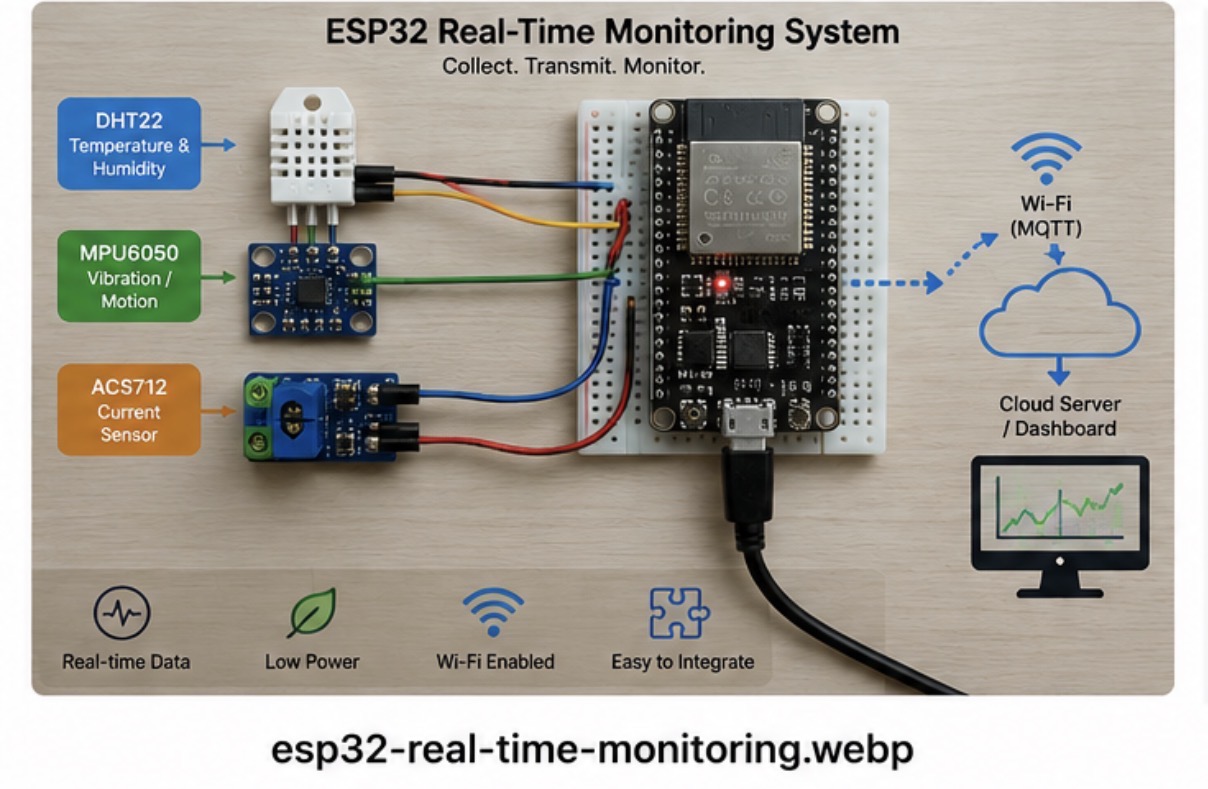
Common IoT sensors include:
| Sensor Type | Application |
|---|---|
| Temperature Sensors | Equipment heat monitoring |
| Humidity Sensors | Environmental control |
| Vibration Sensors | Predictive maintenance |
| Current Sensors | Energy monitoring |
| Pressure Sensors | Industrial pipelines |
| Motion Sensors | Occupancy detection |
| Gas Sensors | Air quality monitoring |
| Ultrasonic Sensors | Tank level monitoring |
These sensors are typically connected to microcontrollers such as ESP32, Arduino, or industrial PLC systems.
How IoT Sensors Send Data
IoT sensors collect data continuously and transmit it to cloud servers or local gateways using communication protocols.
The most common methods include:
- Wi-Fi
- Ethernet
- LoRaWAN
- NB-IoT
- MQTT
- HTTP APIs
For example, an ESP32 device can read temperature data every few seconds and send JSON telemetry data to a cloud monitoring platform.
{
  "temperature": 32.5,
  "humidity": 68,
  "device_id": "ESP32_001"
}
This data is then processed by backend systems for visualization, analytics, and alerting.
MQTT vs HTTP for IoT Monitoring
Two common communication methods for IoT systems are MQTT and HTTP.
MQTT
MQTT is a lightweight publish-subscribe protocol designed for IoT systems. Advantages:
- Low bandwidth usage
- Faster communication
- Ideal for real-time telemetry
- Efficient for large-scale sensor deployments
HTTP
HTTP is simpler and widely supported. Advantages:
- Easy integration
- REST API compatibility
- Good for basic cloud communication
For industrial real-time monitoring systems, MQTT is generally preferred because of its low latency and efficiency.
Example IoT Monitoring Architecture
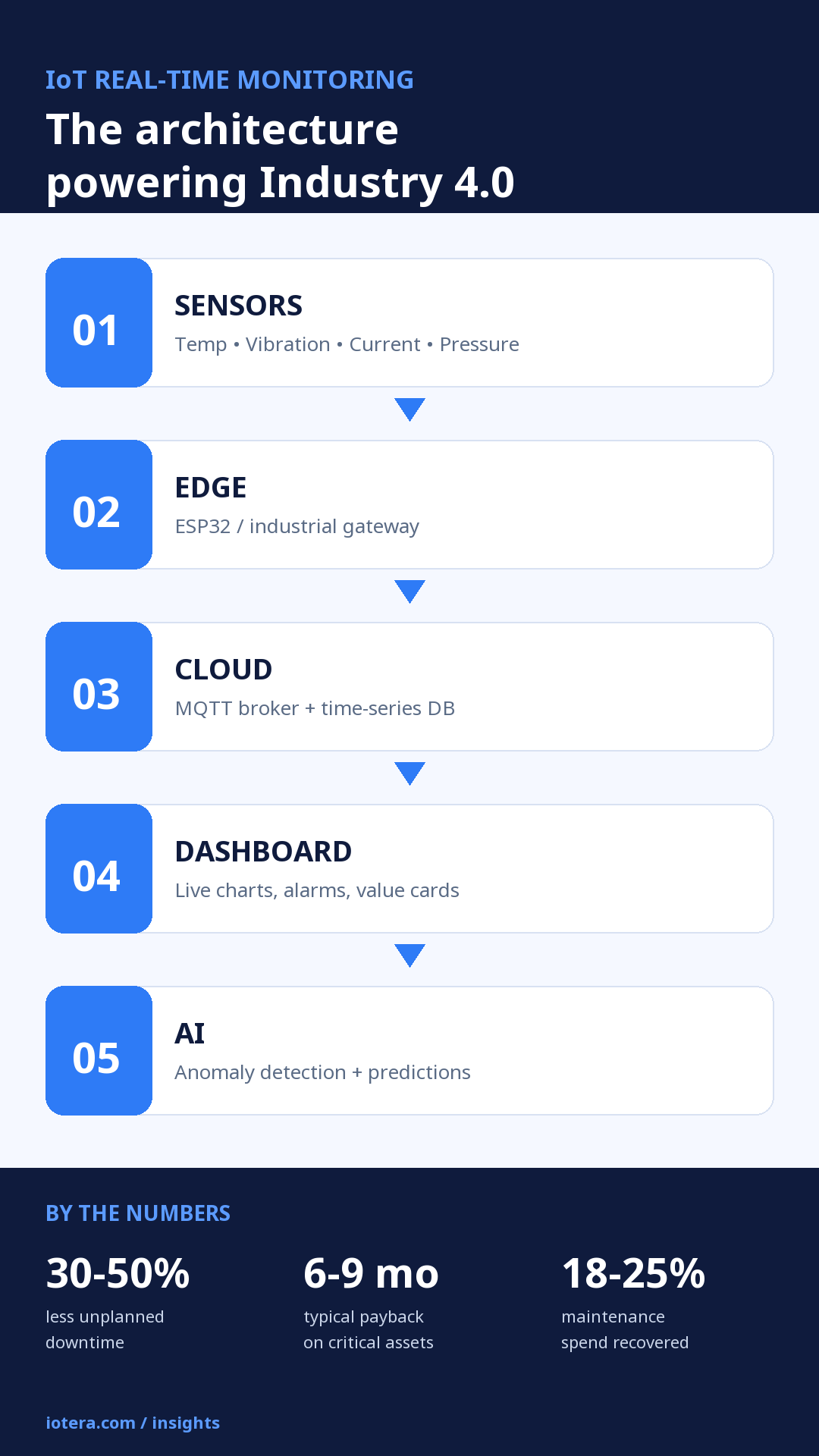
A modern IoT monitoring system typically consists of:
- Sensors — collect environmental or equipment data
- Edge Devices — ESP32 or industrial gateways process and transmit data
- Cloud Backend — receives telemetry using APIs or MQTT brokers
- Database — stores historical telemetry for analytics
- Dashboard — visualizes live and historical data
- AI Analytics — detects anomalies and predicts failures
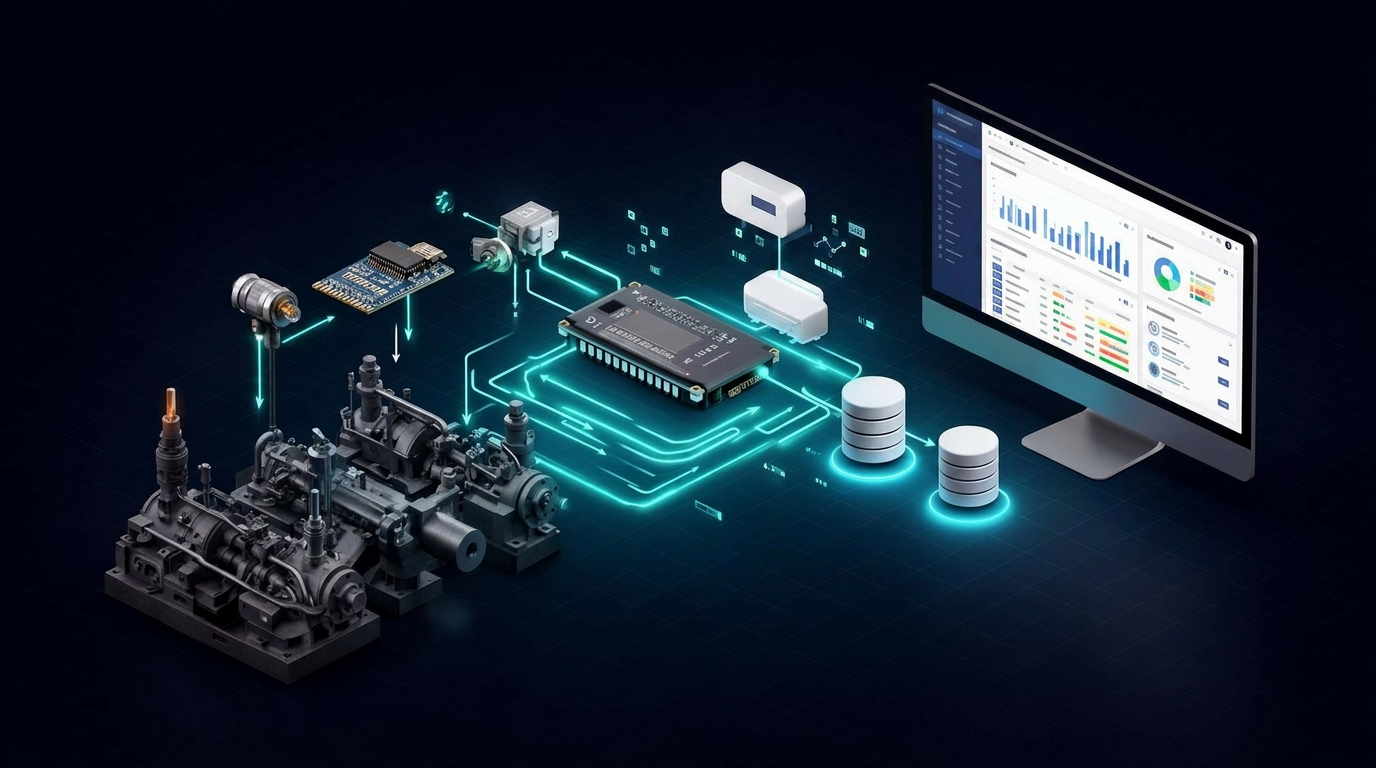
A common architecture may use ESP32 devices, FastAPI backend, PostgreSQL database, React dashboard, WebSocket live updates, and AI anomaly detection services.
Real-Time Dashboard Visualization
One of the most important components of an IoT monitoring system is the dashboard. Dashboards allow operators to:
- Monitor live sensor readings
- View trends and charts
- Track alarms and alerts
- Analyze equipment health
- Observe operational performance
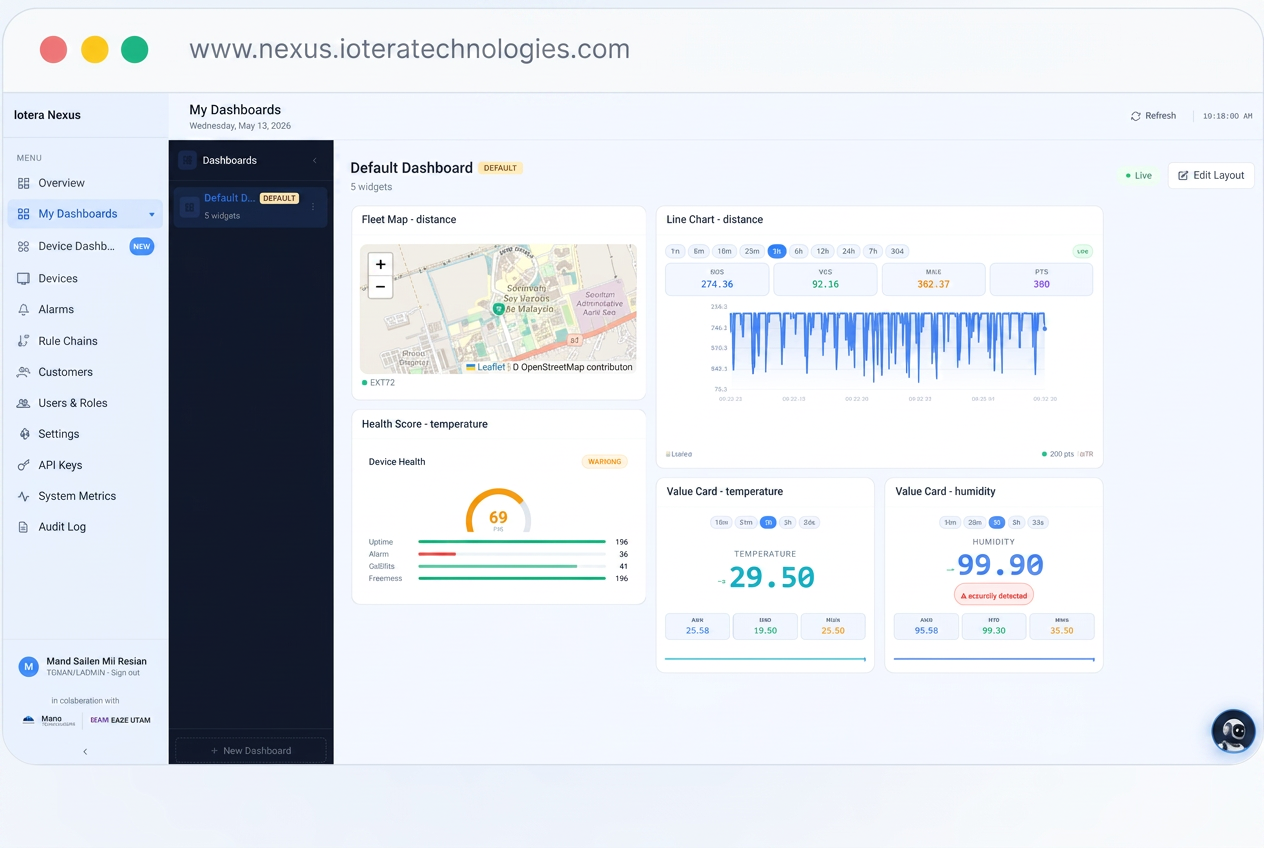
Modern dashboards often include live telemetry cards, time-series charts, alarm panels, predictive maintenance insights, and AI-generated recommendations. Real-time visualization significantly improves situational awareness for industrial operations.
AI and Predictive Monitoring
Traditional monitoring systems only display raw sensor data. Modern AI-powered platforms go further by analyzing patterns and predicting failures before breakdowns occur.
AI algorithms can detect:
- Abnormal temperature spikes
- Unusual vibration patterns
- Equipment degradation
- Operational inefficiencies
Predictive monitoring reduces downtime, maintenance costs, and unexpected equipment failures. For example, vibration sensors on industrial motors can identify bearing wear early using anomaly detection algorithms — allowing maintenance teams to act before catastrophic failures occur.
Industrial Applications of IoT Monitoring
- Manufacturing — monitor machine performance, production efficiency, and equipment health
- Data Centers — track cooling systems, power usage, and environmental conditions
- Smart Agriculture — monitor soil moisture, temperature, and irrigation systems
- Water Treatment Plants — observe pump conditions, tank levels, and water quality
- Smart Buildings — control lighting, HVAC systems, and occupancy monitoring
Benefits of Real-Time IoT Monitoring
Organizations implementing IoT monitoring systems can achieve:
- Reduced downtime — detect issues before failures happen
- Improved efficiency — optimize equipment usage and energy consumption
- Faster decision-making — access live operational data instantly
- Predictive maintenance — schedule maintenance proactively
- Remote accessibility — monitor facilities from anywhere
- Scalability — easily expand monitoring across multiple sites
Best Practices for Implementing IoT Monitoring Systems
To build a reliable IoT monitoring solution, organizations should:
- Use reliable industrial-grade sensors for accuracy and durability
- Ensure stable connectivity with reliable network infrastructure
- Implement security with authentication, encryption, and secure APIs
- Store historical data to enable trend analysis and AI training
- Use AI analytics for intelligence beyond basic visualization
- Design scalable architecture that supports future expansion
The Future of AI-Powered IoT Monitoring
The future of industrial monitoring is moving toward autonomous intelligent operations powered by AI and edge computing. Emerging technologies include:
- Edge AI analytics
- Autonomous maintenance systems
- Computer vision monitoring
- AI agents for industrial operations
- Digital twins
- Self-healing infrastructure
Organizations adopting AI-powered IoT platforms today will gain a significant competitive advantage in operational efficiency and reliability.
Conclusion
IoT sensors have transformed how industries monitor and manage operations. By combining real-time telemetry, cloud dashboards, and AI analytics, organizations can achieve smarter, safer, and more efficient industrial systems.
Whether used in factories, data centers, agriculture, or smart buildings, real-time IoT monitoring enables proactive decision-making and predictive maintenance capabilities that were previously impossible with traditional monitoring systems.
As AI and IoT technologies continue to evolve, real-time monitoring will become a critical foundation for the next generation of intelligent industrial operations.
FAQ
What is IoT real-time monitoring?
IoT real-time monitoring is the continuous collection and analysis of live sensor data using connected IoT devices.
Which sensors are commonly used in industrial IoT?
Temperature, vibration, humidity, current, pressure, and gas sensors are commonly used.
Why is MQTT preferred for IoT systems?
MQTT is lightweight, fast, and optimized for real-time telemetry communication.
Can AI improve IoT monitoring?
Yes. AI enables predictive maintenance, anomaly detection, and intelligent operational insights.
What hardware is commonly used for IoT monitoring?
ESP32, Arduino, Raspberry Pi, industrial PLCs, and edge gateways are commonly used.
Keep reading
AI-powered IoT monitoring solutions for industrial operations
How combining computer vision, predictive analytics, and real-time IoT telemetry is reshaping uptime, safety, and cost in modern industrial plants.
Predictive AnalyticsThe real ROI of predictive maintenance
Where AI-driven maintenance pays back, where it doesn't, and why you should distrust the percentage in every vendor deck.